
Stories from Noordwijk aan Zee
How Noordwijk learnt to take a summer holiday
A century ago, a family did not come to Noordwijk for a quick weekend by the sea. Trunks were unpacked, children settled in and the summer stretched ahead. City families stayed for weeks, sometimes most of the season. Meanwhile, Noordwijk families discovered a clever way to make room: they moved into the little summer house at the end of the garden and gave the guests the main house.
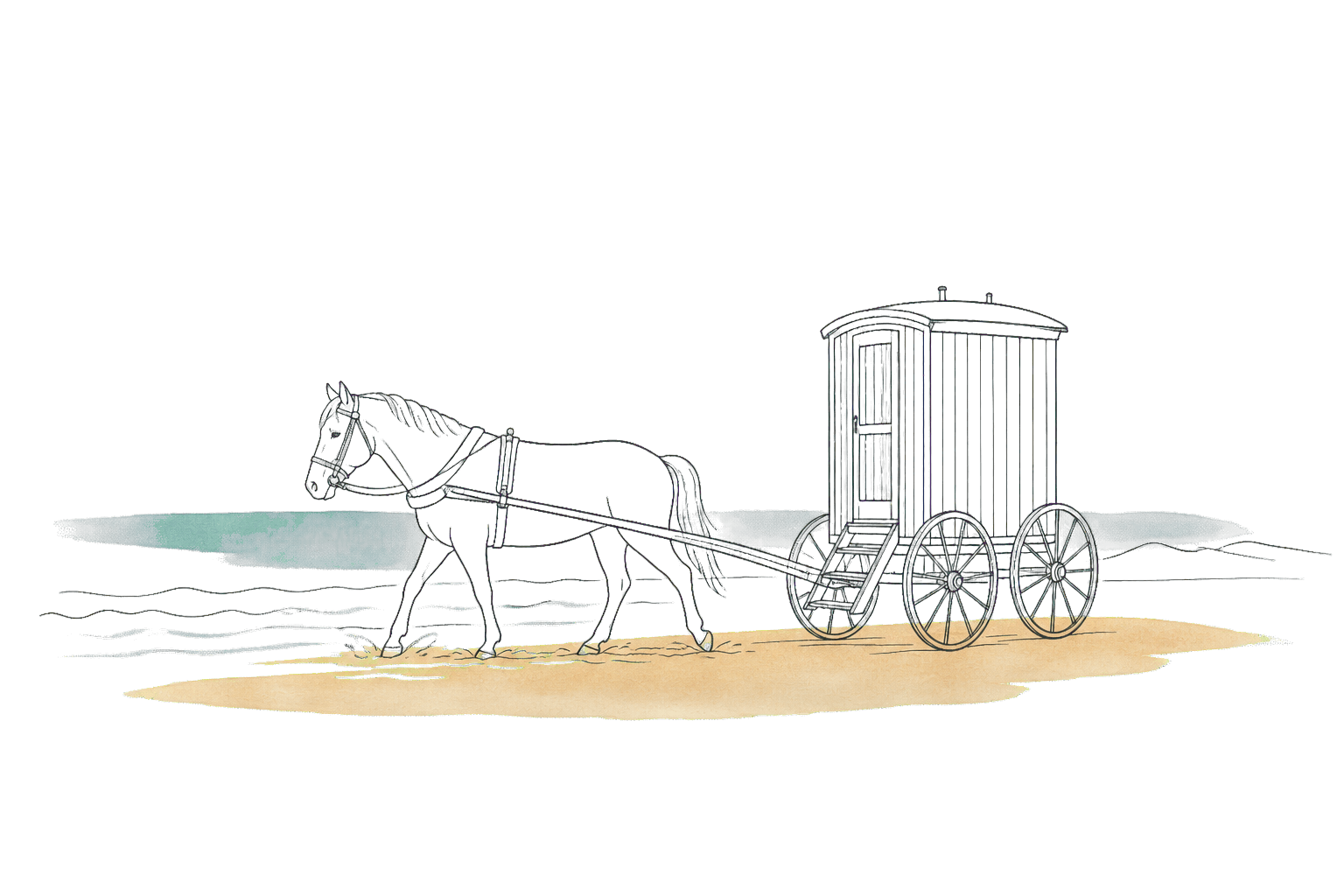
- A bathing carriage carried its passenger right into the North Sea
- German guests helped turn Noordwijk into a seaside resort
- Local families spent the summer behind their own house
- Our house on Duinweg has watched the seasons change since 1933
Into the sea by horse-drawn carriage
Noordwijk's organised bathing life began in 1866. Visitors climbed into a wooden bathing carriage in their street clothes, changed behind its little door and stayed inside while a horse pulled the carriage into the surf. A bathing attendant waited in the water to help them take their prescribed dip. Sea bathing counted as a treatment; sunbathing came later.
The steam tram connected Leiden and Noordwijk in 1885. Two years later, German hotelier Heinrich Tappenbeck took over Huis ter Duin. His address book included German aristocratic families, and they followed him to the Dutch coast. Long before anyone put up a ‘Zimmer frei’ sign, German voices could be heard on Noordwijk beach.
The suitcase stayed for the summer
The first private summer villas appeared in 1888. Forty years later, Noordwijk counted 50 hotels and boarding houses, 128 houses and apartments for visitors and 89 villas. The elegant resort had become a family seaside town, filled with guests who returned to the same address each year.
Old Noordwijk stories speak of stays lasting six or even eight weeks. A summer holiday was a temporary move. Our house on Duinweg dates from 1933 and, according to the story handed down with it, first welcomed city residents who came for the summer. After the war it became a permanent home, as happened with many houses that had started life around the seaside season.
The guests got the best beds
German holiday travel returned after the Second World War. Noordwijk residents hung signs reading ‘Zimmer frei’ and ‘Zimmer mit Frühstück’ behind their windows. When the rooms were full, the family squeezed into the attic, the shed or the summer house in the back garden. The paying guest slept in the proper bed.
Some travel agents arrived with an entire coach of German families and found a room for everyone. A local advert from June 1965 offered a room with breakfast at Wiener Stube Renova for 8.50 guilders a night, plus fifteen per cent. Tourism income reached bakers, greengrocers and dozens of households in the streets behind the large hotels.
Blankets on the beach in August
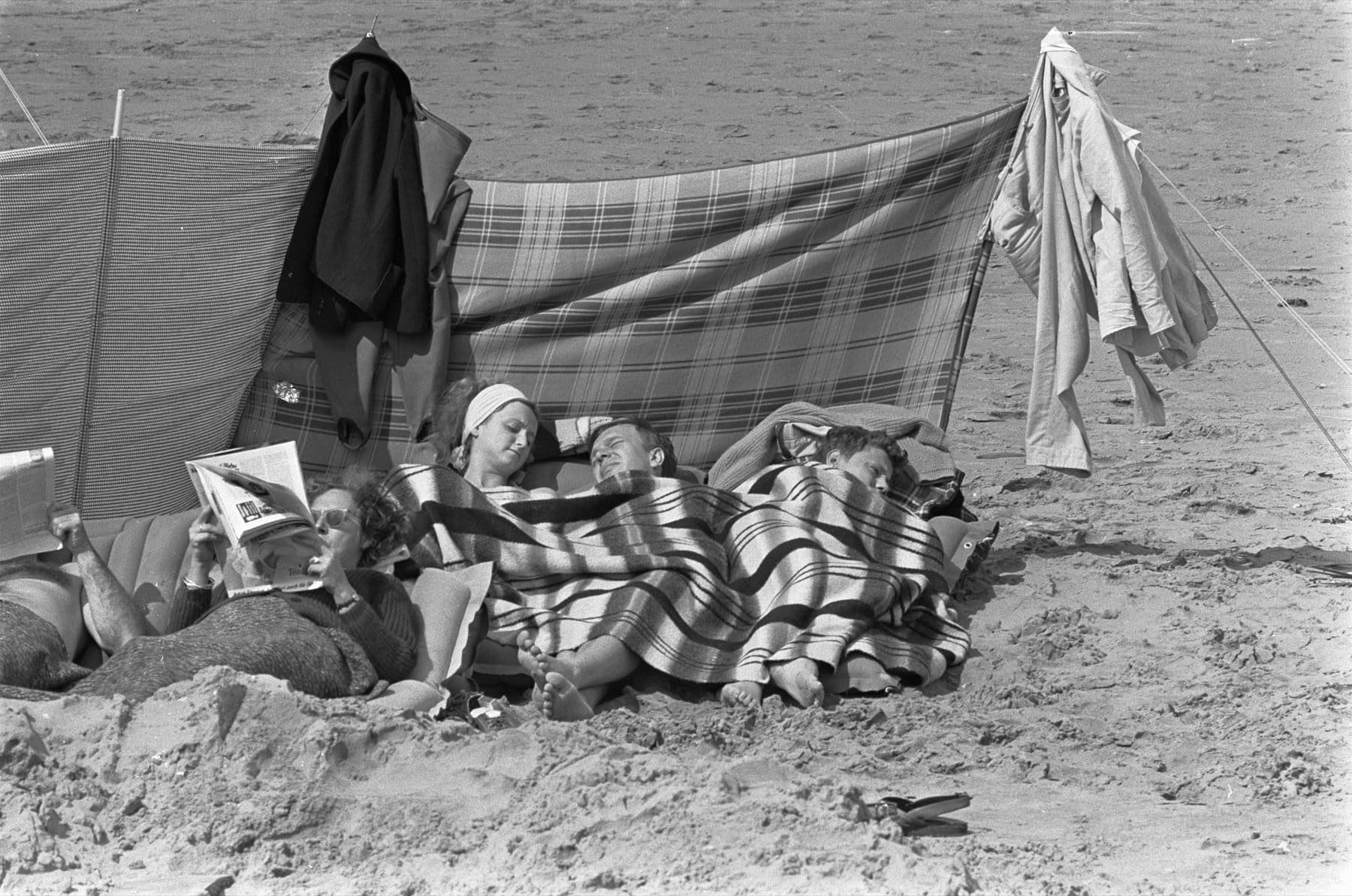
Photographer Hans Steinmeier visited Noordwijk beach on 2 August 1966. He found five holidaymakers tucked beneath striped woollen blankets, sheltered by a checked windbreak. One reads a book, another holds a newspaper and bare feet stick out into the sand.
The photograph captures a very Dutch pact with the weather: come for the sea, bring enough wool for the North Sea wind. Those guests had time to wait. Their room would still be theirs tomorrow and for several weeks after that.
Then Spain moved closer
Package tours and cheaper flights gave families a new choice in the 1960s and 1970s: guaranteed sun on the Mediterranean. Dutch airports handled 1.45 million passengers in 1960 and 6.81 million in 1972. Spain changed from a distant dream into a holiday that ordinary families could book.
The rhythm in Noordwijk changed with it. A stay of many weeks became a fortnight, a week or a few days by the sea. Guests still came, but they unpacked less and wanted more freedom. Hotels, boarding houses and private hosts all adapted to the shorter visit.
A small house finds new residents
The summer houses behind Noordwijk homes took on new roles. Some housed a student, a starter or someone waiting for a permanent place. Others returned to holiday use, now for short stays instead of a whole season. The little buildings proved easy to adapt because they had always stood between home and holiday.
Our own summer house now welcomes two guests at a time. They have both floors, a private courtyard and their own Finnish sauna. Their suitcases may stay for only a few nights, but the old Noordwijk ritual remains: close the door behind you, walk to the sea and live at the pace of the beach.
FAQ
The Noordwijk summer house in brief
Why are there so many summer houses in Noordwijk?
Many residents built a small house in the back garden so they could live there during the season and rent the main house or its rooms to seaside guests.
Why did so many German guests come to Noordwijk?
German visitors helped establish Noordwijk as a seaside resort from the late nineteenth century. After the Second World War, returning German families filled hotels, boarding houses and rooms in private homes.
How old is the house at Romantic Wellness B&B?
The main house on Duinweg dates from 1933 and is approaching its hundredth birthday. The story handed down with the house says city residents first used it as a summer home.
Can we stay in a summer house in Noordwijk today?
Yes. Romantic Wellness B&B offers a private two-storey summer house for two with a Finnish sauna, private entrance and courtyard garden, about ten minutes on foot from the beach and dunes.
For readers who want to know more
- Noordwijk 2030 environmental vision: tourism history and the backyard summer-house custom
- Cultural Heritage Platform Noordwijk: the seaside resort, bathing carriages and boarding houses
- Provincial heritage survey of Noordwijk: villas, visitor numbers and post-war development
- Dutch National Archives: Noordwijk beach visitors under blankets, 2 August 1966
- Statistics Netherlands: aviation passenger growth, 1960–1972
- Local Noordwijk memory: a room with breakfast for 8.50 guilders in 1965